


Double click image to enlarge
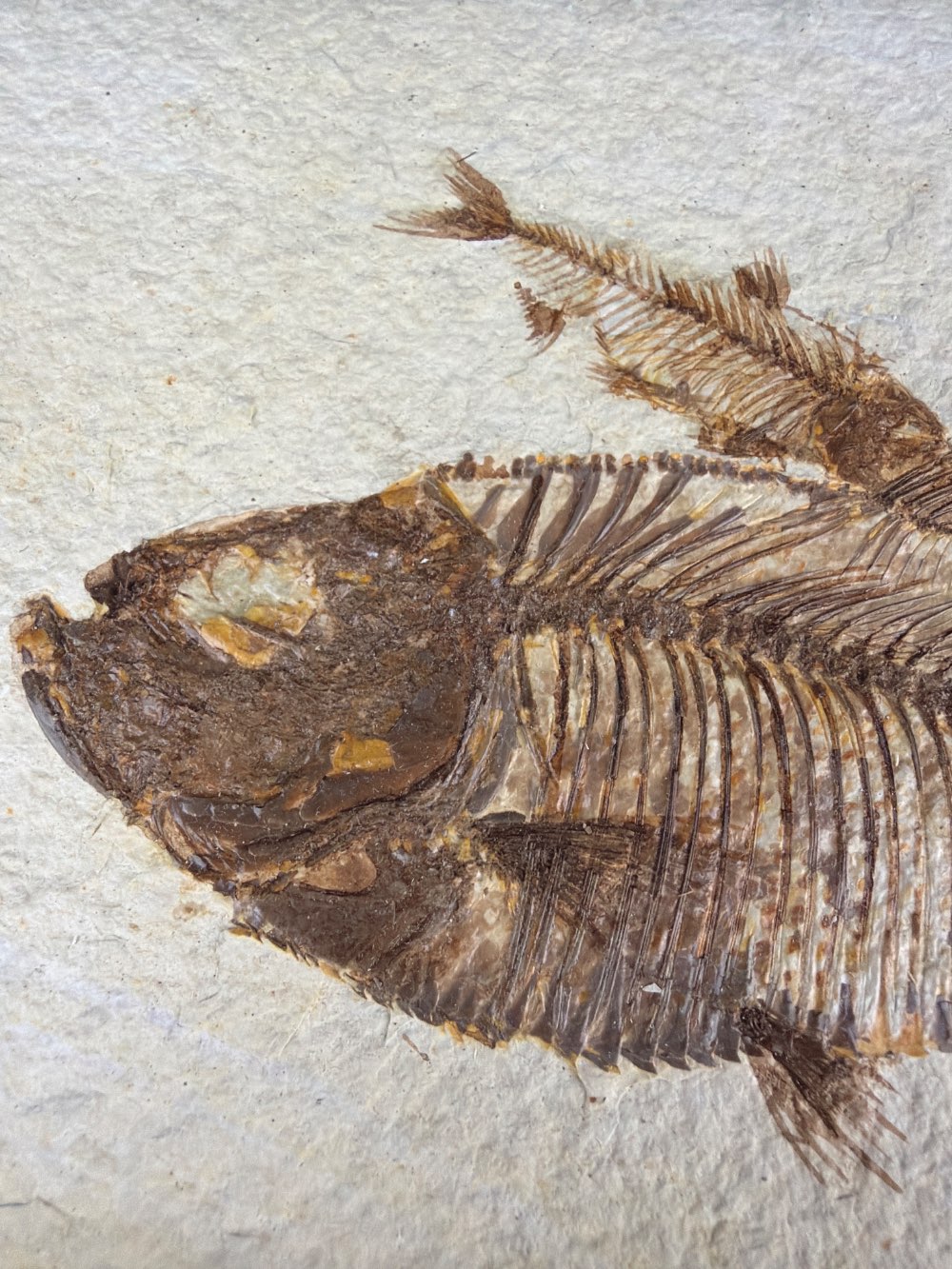
Diplomystus dentatus and knightia eocaena fish fossil from Green river formation, Kemmerer Wyoming
Diplomystus dentatus and knightia eocaena fish fossil from Green river formation, Kemmerer Wyoming
- Country: USA
- Region: Green River formation, Kemmerer Wyoming
- Period: Middle Eocene Lutatian (48.07-41.03 million years old)
- Material: Fish fossil in fine-grained, laminated limestone matrix
- Size slab: 15.5 x 22.5 cm
- Size fish: 17 and 6 cm
- Weight: 684 gram
Knightia eocaena
Knightia was a small, herring-like ray-finned fish and by far the most abundant fish in Fossil Lake. The National Park Service describes K. eocaena as the most common fish in Fossil Lake and the most commonly found articulated vertebrate fossil in the world. It is also Wyoming's state fossil.
Typical adults were around 15 cm, although specimens approaching 10 inches have been found. They appear in mass-mortality layers containing very large numbers of individuals, indicating that they were schooling fish.
Ecologically, Knightia was probably an important forage fish—small enough to be eaten by larger fish such as Diplomystus.
Diplomystus dentatus
Diplomystus was substantially different. It was a larger predatory fish with a distinctive deep body, upturned mouth, and long anal fin. The upturned mouth is particularly interesting because it indicates feeding near the surface of the lake.
It could become quite large: Fossil Butte National Monument reports D. dentatus specimens ranging from tiny embryonic individuals to about 66 cm. It was the second-most-common fossil fish in Fossil Lake.
And here's the really fascinating part: Diplomystus specimens are sometimes found with other fish—including Knightia—actually in their mouths. Some specimens apparently died while trying to swallow prey.
What Kemmerer was like ~50 million years ago
The fossils come from Fossil Lake, one of the major ancient lakes represented by the Green River Formation. The exceptionally fine-grained lake sediments could preserve entire fish, including bones, scales and delicate anatomical details. Certain laminated layers represent extraordinarily concentrated fossil assemblages.
So a slab containing both species can potentially capture a snapshot of a real predator-prey relationship:
Fossil Lake → schooling Knightia → predatory Diplomystus → death and rapid burial → fossil
That doesn't mean every slab with the two species, like this one, represents an actual predation event, but specimens with a Knightia physically inside a Diplomystus are compelling evidence that Knightia was among its prey.
One particularly useful distinction
If you're looking at specimens from a Kemmerer quarry, Diplomystus and Knightia can sometimes be confused, especially when the specimen is small or incomplete.
Diplomystus
- Much deeper-bodied toward the front
- Characteristic hump/deep region immediately behind the head
- Upturned mouth
- Long anal fin
- Deeply forked tail
- Generally more robust-looking
Knightia
- More uniformly streamlined
- Smaller head
- Less dramatic body depth
- Herring-like proportions
- Often found in huge concentrations/mass-death plates
Please send an e-mail via below form, WhatsApp or call to order or get more information about this object.
We can communicate in English, Deutsch and Nederlands!
Diplomystus dentatus and knightia eocaena fish fossil from Green river formation, Kemmerer Wyoming