




Double click image to enlarge
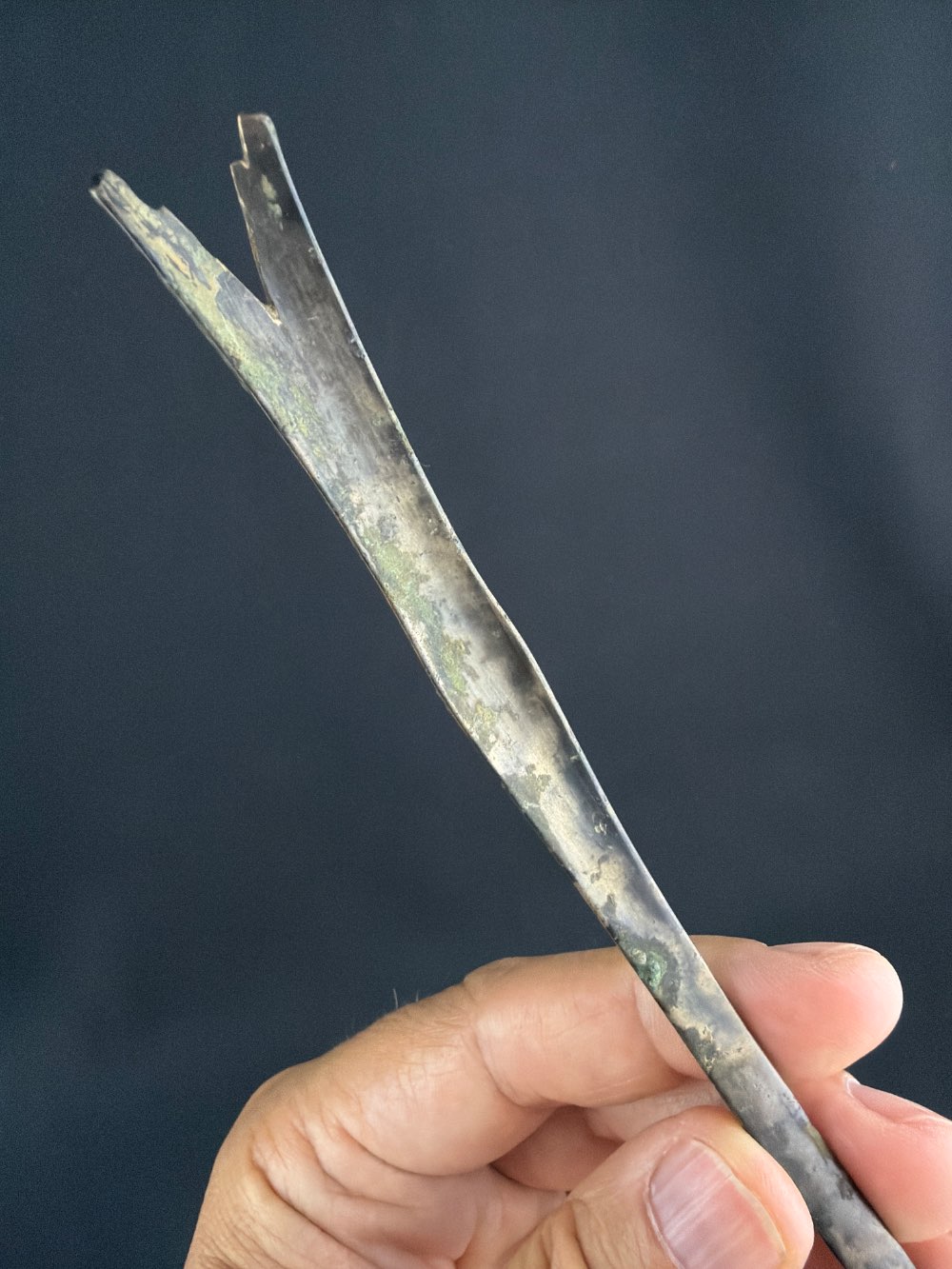
Korean bronze spoon from the Goryeo Dynasty (918-1392)
Korean bronze spoon from the Goryeo Dynasty (918-1392)
- Country: Korea
- Period: Goryeo Dynasty (918-1392)
- Material: silvery bronze
- Size: 28.4 cm
- Weight: 48 grams
- The acrylic stand is included
- Condition: With age-related wear and weathering and some cracks at the bowl. Some restoration attempts at the bowl.
- An elegant bronze spoon from the Goryeo dynasty, characterized by its elongated bowl and gently curved handle. The restrained form reflects the refined simplicity of Goryeo metalwork, while its use as both a domestic utensil and burial object provides a fascinating insight into medieval Korean dining customs and funerary traditions.
-
Bronze spoons were widely used during the Goryeo dynasty and have been found at numerous archaeological sites, including tombs. The characteristic Goryeo form has a relatively shallow, elongated bowl and a long, gently curved handle. Some examples (like this one) have distinctive swallow-tail (yeonmi-hyeong) finials, while others have pointed or spade-shaped ends.
The spoons were generally made from copper alloy (bronze). Interestingly, surviving examples were not necessarily all cast: the Metropolitan Museum notes that some Goryeo spoons were hammered from flat sheets of metal, meaning that each spoon could have its own subtle shape and character.
Their archaeological importance is considerable. Bronze spoons are among the most common burial objects associated with the Goryeo period, sometimes found together with bronze chopsticks. The National Museum of Korea has, for example, a Goryeo set containing eight bronze spoons and two pairs of chopsticks.
The fact that spoons were so prominent in Korea is also culturally significant. Unlike traditional Chinese dining, where spoons were more commonly used as ladles, the spoon became an integral part of the Korean meal, particularly for eating rice and soups. The National Museum of Korea describes the Goryeo period as the time when the characteristic Korean spoon form became standardized.
Please send an e-mail via below form, WhatsApp or call to order or get more information about this object.
We can communicate in English, Deutsch and Nederlands!
Korean bronze spoon from the Goryeo Dynasty (918-1392)